
By Annunziata Gianzero
A college grad recently asked me how he should query realtors when shopping for downtown apartments. I quickly responded with an array of questions ranging from: “What’s the closest subway?” to “Do they cover utilities?” and then instinctively added, “But where’s the nearest Van Leeuwen ice cream shop?” So, let’s just say that I have a sweets addiction…which is not unique. (Have you ever been to Dylan’s Candy Bar in Union Square? Bring your sweet tooth and see if you can escape for under $40). But I have another problem which isn’t unique either—a love of all things filmic. That problem is magnified when presented with an entertainment “candy shop” like the Tribeca Film Festival.
What’s new in film festivals is that they now resemble film “theme parks,” incorporating television, internet, virtual reality, masterclasses, musical performances, games, panels, and even “food pairings.” All of that can be hard to navigate. Type A personalities try to schedule with color-coded calendars and phone alerts but, at the end of the day, they will likely be unable to adhere to most of their plans.
So how do you conquer Tribeca? You accept that the beauty of the festival is that you will stumble upon the unlikeliest of gems. So don’t overschedule, leave room for fate, and try to include the following:
Shorts, Foreign Films, and True Indies
DON’T listen to the pre-festival buzz. It’s fake news at its finest. Be brave. Try something “off-brand.” Oftentimes, the most-touted films, peppered with celebrities, are disappointments, while the tiny offerings with little hype and even smaller audiences are the real festival highlights (e.g., the infamous screening of Clerks to only the film crew and one guy who would change the fate of Kevin Smith). Everyone secretly wants to be a part of that. That’s why you go to a festival—to find something rare, fresh, and wonderful. Otherwise, you may as well just go to the movies.
Since cable channels now buy up festival films* and even air them weeks later, I’ve re-prioritized my schedule, earmarking what I can’t readily experience after the festival ends. Rule of thumb: Galas or Spotlight films with celebrity casts are likely to be released widely (unless they’re unwatchable), so small foreign films and short films get my attention, especially at a festival of this caliber.
This year, I caught a collection of shorts entitled New York – Group Therapy, which included a fun film about a wedding night gone awry when the newlyweds begin to suspect that they may have married a “lemon” (Lemon by Timothy Cooper) and a gut-wrenching short by Jim Sheridan (11th Hour) about 9/11 that left me sobbing in my seat. To this date, I believe no filmmaker has captured that event more truthfully and viscerally, though many have tried. Sometimes you may see a short which later on becomes a feature and you’ve gotten to witness the seed of the story—one of the unique benefits a festival provides.
Panels (a.k.a. Tribeca Talks)
Panels are one of the uniquely valuable festival offerings and you really never know which ones will be the best choices. There are lots of variables—just pick topics you’re interested in and catch as many as you can.
The Lena Dunham/Jenni Konner Storytellers Talk (which was overcrowded) was funny but ultimately wasn’t chock full of valuable information. By contrast, the digital horror outlet CryptTV screening (part of the Tribeca N.O.W. section) and the talkback afterward was particularly enlightening. Not only were the attendees an interesting bunch, but panelists were especially informative with respect to how the audiences and avenues have changed. As Crypt’s founder Eli Roth stated, they’re not thinking of short films in terms of spawning features anymore, but rather as creating characters, stories, and mythologies which spin off into series.
Virtual Reality (a.k.a. Virtual Arcade & Storyscapes)
Film festivals have not only grown to meet our varying tastes, they have grown up to embrace technology.
My very first experience with Virtual Reality (VR) was at the Tribeca Film Festival and I was really impressed—so impressed that I remember never wanting to make a film without an immersive element again. The stories came alive in a brand new way. I rode dragons (Dragonflight) and eavesdropped on a ghetto bodega shooting (Hard World for Small Things), so I was eager to return to witness the evolution. Clearly, it’s grown by leaps and bounds because, suddenly, when I talk about VR, people don’t look at me like I have three heads. And that’s a great milestone because, although it’s fun to be ahead of the curve, the fact that no one really gets what you’re talking about doesn’t always yield a mutually valuable conversation.
But, this year, it became abundantly clear that VR is grabbing attention. The Obamas made a VR film (The People’s House by Felix and Paul Studios) in which they tour the White House with you. It’s kind of amazing and technically superb. I wished that every schoolkid could enjoy it as part of his/her curriculum. One woman, clearly disenfranchised by the current administration, asked the VR handler, “Do I have to come back to reality?” because, politically, things felt rather bleak on the other side of her goggles.
I had to become a detective to get a viewing of the VR installation To Be with Hamlet. Being a sometime- Shakespearean actor, I placed it high on my list. Though it was printed in the schedule, it seemed that no one knew when or where it was showing. But when I went to the Arcade one day, eight days into the festival, it suddenly appeared. It was, bar none, the best Virtual Arcade presentation I experienced at the festival. While actors in Brooklyn provided the movement and voicing of the characters in Hamlet through motion-capture as they played out the scenes, we were placed inside the story on the castle premises and could move within it. It was technically complicated, visually beautiful, and a solidly entertaining use of the blended mediums of live theatre and VR.
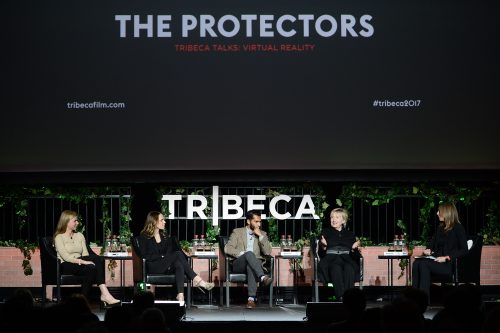
And then there’s this: the highlight of my experience. What could be better than VR or a panel? Kathryn Bigelow’s Talk which included her VR documentary, The Protectors, followed by a panel. We donned goggles to experience this provocative piece about the unfortunate plight of the Congo elephants and the rangers who are their “protectors.” Then Tribeca co-founder Jane Rosenthal stepped up to introduce a very special surprise guest as “our indispensable protector,” and out walked none other than Hillary Clinton to serve on the panel. It is safe to say that VR has made a mark.
These are some of my other VR experiences (in no particular order):
Tree Hugger – This is a VR/AR piece in which you actually stick your head into a virtual tree and move around in the world of the tree. With direction from the installation’s staff, you get more out of it because you learn how to move your arms and touch the ground to affect the environment and to have a more interactive experience.
Auto – A cabbie who has lost his job is forced to take the only similar job available to him now—that of a driver of the new “driverless” cabs. The tech versus human theme is a clever pairing of this new 360-degree storytelling technique as an ironic delivery device for this particular story.
Testimony – This is a powerful piece which alternates between interview story-bites of real rape and abuse victims. The interactive VR component allows you to switch between stories with your head movement (which cues the pointer to another speaker). The subject matter is intense and sometimes even hard to watch, as these stories often are. The creator, Zohar, explained that the experience is not for everyone but it’s incredibly powerful material.
Step to the Line – This is another social issues documentary which takes the viewer into the prison system. There are scenes where you visit convicts’ cells (a bit unnerving because you’re “in” the cell with them) and scenes in which you watch them graduate from prison education programs. They are woven together by a master scene in which convicts, prison staff, and educators stand on either side of a line on the floor. By “stepping up” to it, they admit to personal experiences and beliefs intended to demonstrate their similarities despite differing backgrounds. It’s an intense study in empathy through VR.
Life of Us (Chris Milk, Aaron Koblin) – This is a shared VR journey with avatars. Chris Milk is a pioneer in this area and it shows. Life of Us is a really intricate experience wherein you and a friend travel through animated tableaus…except you’re avatars. How do you know you’re an avatar? Because your friend looks like you—and she’s a gorilla, a robot, a cartoon businessman. And you can speak to each other as your voice gets altered in funny ways. At Sundance, you had the added benefit of sharing the adventure with two other people experiencing it simultaneously down the street in a separate installation. But, since the Life of Us experience was limited to one location, that Sundance feature was not included at Tribeca. You can also watch a flat-screen recording of your experience afterward.
Becoming Homeless – This is a participatory experience where you live inside a story in which you lose your home. After you sell your possessions, you move to your car and your circumstances devolve from there. The film is not live-action but it is realized in 3-D animation. There’s something about VR that makes the experience feel especially real and emotionally affecting.
Remember Remember – This is another excellent rendering of a 3-D animated experience. The sci-fi brainwashing story elements are not groundbreaking, however, this time you can walk around the 3-D space (in room scale) to enhance your perspective. Technically, it’s top-notch.
Community
The parties were fun but there were none which I couldn’t have skipped. More networking gets done at the Tribeca Film Festival Hub (at 50 Varick Street) and the panels, so I wouldn’t schedule around them. Just drop in when there’s nothing else on your plate.
All of the lounges at the Hub were inviting, well thought-out, and well-sponsored, meaning that it’s easy to say to a fellow creator, “Hey, they’ve got Nutella crepes and lavender Nespresso cappuccinos at the Hub, let’s meet there first thing,” or “How about a cocktail confab on the rooftop bar?” Conveniently, this is where the Virtual Arcade and Tribeca Talks were also hosted. The only issue, which was unanimously voiced among my colleagues, was that theatres are at least two miles from the Hub and stretch three miles from each other; that makes it almost impossible to catch a film at each venue within hours of the other. You have to decide where your best options are and stick that out for half the day. Ultimately, you break a lot of dates and miss a fair amount of films. Because of this, buying tickets ahead of time is not always the best tactic. It’s better to take your chances on the rush lines, where the odds are pretty good that you will get in.
So just show up. Remember when I said embrace the unexpected? The biggest festival takeaway is the human common denominator—the discussion of the films, the networking, and the after-screening Q&As. It all fosters a film community that you can retain for years.
* Note: Netflix and Amazon collectively spent just under $60 million at Sundance this year.
Below, please find the links which pertain to this article:

