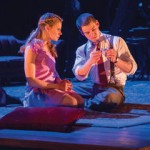
October 6, 2013 – Lady Day at the Little Shubert Theatre written and directed by Stephen Stahl, with Dee Dee Bridgewater, who stars and commands the stage as Billie Holiday.
The production is framed simply. Act One takes place during a rehearsal on the stage of a London theater on a rainy afternoon in late November 1954. This is significant because of drug problems restricting Ms. Holiday from performing wherever booze was sold in the US, thus relegating her to concerts and performing abroad. The rehearsal allows the presentation of a number of Holiday classics performed in a natural setting. A small musical group on stage is preparing for an evening concert and working out the kinks with a reluctant Billie trying to get comfortable with the contrast to the club settings to which she .
Act Two gives us the concert and we see Billie, badge of honor white gardenia behind her ear and in a glamorous white gown, sing her heart and soul out. It’s wonderful to hear her music again and be reminded that Billie Holiday was a profound Jazz presence. She was then, in the late 40s and 50s, the dominant singer of her day. Although now long gone, she remains in the public memory and conscience as fresh and as revered as ever. Together with her fabulous repertoire of songs, we see snippets of her past, dramatized linkage, to create a play. It’s all meant to suggest who and why she was, as if illustrations could give any insights into why an artist is an artist. I would have been happy with less of Mr. Stahl’s background drama and more of Billie Holiday’s unique lyrical musicality but then it would have been a concert not a musical. Perhaps it should have remained a concert in profile. I suppose I wish Mr. Stahl had been more inspired.
Billie Holiday really tells us all we need to know in her songs. “Don’t Explain,” music by Billie Holiday, lyrics by Arthur Herzog Jr. says it all. What is there to explain? If you need more, she sings, “God Bless The Child,” music by Billie Holiday, lyrics by Arthur Herzog Jr. He wrote the words you can be sure, however, Billie’s sentiment pours through him. Most telling about Billie Holiday’s sensibility is her pursuing and demanding that she record, “Strange Fruit,” an emotional anthem about the lynching of a black man. Her label, Columbia Records, would not allow her to record the piece “due to subject matter.” Holiday pushed the song on an alternate small label, Commodore, and the song became history and a musical classic. This powerful and shockingly graphic song about racial hatred was her personal form and protest against racism, fascism and all other isms in play at the time. She was courageous and committed to her times and her art. She was a Jazz singer at one with her music. She had no professional training but the unique diction, inimitable phrasing, and acute dramatic intensity put her in a class by herself, whispered in the same breath as Louis Armstrong and Bessie Smith. Billie Holiday, a musical legend in her own lifetime, died tragically at 44. Her smoky, evocative voice, innovative techniques, and passionately moving songs will, hopefully forever, be remembered and enjoyed.
That brings me to Dee Dee Bridgewater, four decades a Grammy and Tony-winning Jazz vocalist. She received the Lawrence Olivier nomination for Best Actress in a Musical in England for, Lady Day. To celebrate the talent, individuality, and uniqueness of the renowned Billie Holiday is a great compliment, and a huge responsibility. Dee Dee rightly doesn’t try to mimic Ms. Holiday. She gives us her version. Her honesty, energy, and very persuasive musical ability recreate for us her Billie Holiday. It’s pure in its own way and reflective of that once Jazz greatness. She also sings her heart out on the stage in her celebration of Billie Holiday. She is a suggestion of what Billie Holiday must have been but a suggestion that burns brightly and we are grateful for her presence. She shows us the style, the presentation, and the persona of Lady Day.
October 18, 2013 – A Time to Kill, based on the novel by John Grisham, adapted for the stage by Rupert Holmes, directed by Ethan McSweeny, produced by Daryl Roth and Eva Price at The Golden Theatre, Broadway.
This timely drama certainly is relevant today and will resonate with wide audiences in this Trayvon Martin era even though it was John Grisham’s first novel, published in 1988. It is also the first of Mr. Grisham’s novels that he has allowed to be done on the stage.
A Time To Kill tells the emotionally charged, now ironic story, of a young idealistic lawyer, Jake Brigance, defending a black man, Carl Lee Hailey, for taking the law into his own hands following the unspeakable crime against his young 10-year-old daughter. Their small Mississippi town is thrown into upheaval and Jake finds himself arguing against the formidable District Attorney, Rufus Buckley, and under attack from both sides of a racially divided city. The drama of the courtroom battle concerns the true nature of what is right and what is moral.
Adaptations are hard. They have their own responsibilities and writers face adaptations with trepidation. One must retain the spirit, the heart of the original, and preserve the reason you wanted to move the work to the new medium. Simply you have to change it so it can remain the same. That’s not a contradiction. You have to find or create a form to house the new approach and revised material. The choices are up to the adaptor’s artistic discretion. You have to break up the source material into its component parts and put it back together again so that it means what you mean it to mean for the new medium. I like adaptation and have plenty of experience, from short story to film, novel to film, film to stage, musical film to stage musical and I’ve had a good time doing them all.
In Rupert Holmes’s adaptation for the stage, he is well served by his director Ethan McSweeny. It’s a good production. Sebastian Arcelus plays Jake Brigance. It seems a replica performance of Matthew McConaughey in the film adaptation but without the nuance that McConaughey brought to his performance. On stage Jake seems to start already committed and he continues his defiant defense right through to the end. Even when he momentarily dips, he immediately regains his composure and strides forth to do battle. You never believe that there is an inner struggle. The big surprise for me was the “close your eyes” speech that Jake makes in the film. It is the lynch pin and the key to the acquittal. It is the highpoint in the film. It is powerful and you, in the audience, understand why the jury is swayed to acquit. I was waiting for it. It is the kind of set piece that works wonderfully on the stage. It is direct to the audience. It is devastating. Mr. Holmes did not do it.
I was left staring at the stage. Perhaps if you never read the novel or saw the movie, remember it was made years ago, and didn’t read the paperback, maybe it would work. A black man was acquitted of murdering two white men who brutally raped his daughter and walked home free would be dramatic enough to satisfy.
The film had an undercurrent of nastiness – ripe racism that the play only mildly touches. We don’t feel the rancid menace right below the surface as we do in the film. Mr. Holmes’ theater version feels undernourished, underwritten; a hearty meat stew undercooked. It leaves you still hungry at the end. It really is not the director, the actors or the production. It rests squarely on the shoulders of the playwright, Rupert Holmes. It should have been better.
A Time To Kill opened on October 20th. In adaptation you can step on all the big pieces and stay afloat, but you won’t reach the promised land. I leave this one to you. I was clouded by the film.
Follow Irv’s blog http://www.irvbauerscreenwriting.com/blog