
The Glass Menagerie written by Tennessee Williams in l944 is an autobiographical ‘memory’ play; and it has received mostly rave reviews from the uptown newspaper critics including Ben Brantley who wrote in The New York Times that by the second act he was beyond tears. Despite the accolades accorded to this production, I found that there were serious problems at hand in the direction as well as with two of the lead actors in a play usually regarded by most people – including myself – as a great work of art from a master playwright.
After seeing it, I remembered in Uta Hagens’ acting class, some years ago, her discussing the play itself in glowing terms and in particular citing the performance of Laurette Taylor as Amanda Wingfield, the neurotic, conflicted southern belle character who is patterned after the author’s real life mother. Uta said that she had gone to see and to study Taylors’ acclaimed performance about 10 times. She spoke of the elements the great actress brought to the part, the fragility, the desperation, and the inner devastation – all of this emanating out of her fear of abandonment after having been left by her drunken husband.
Now again in the new production her son, played by Zachary Quinto, following in his father’s footsteps is planning to leave her and his frail crippled sister with no hope of security and no financial help coming from him. Tom aka Tennessee has a job in a St. Louis shoe factory which he hates. He sees himself as a poetic visionary writer and is making plans to escape the oppressive circumstances surrounding him. Outside of his dreary job, he spends most of his time going to the movies or in the late night bars he frequents, hoping for sexual encounters with men. Amanda, in a state of permanent agitation, refers to her son as ‘a selfish dreamer.’
In the current mounting of the play directed by John Tiffany – a founding associate director of the National Theatre of Scotland and associate director at the Royal Court – Cherry Jones in the part of Amanda seems almost too strong for the tormented character who is at her wits end and in the throes of a full-fledged on-the-edge-breakdown. To be sure, Ms. Jones has always been at the top of her game particularly when playing strong-willed women in plays like Major Barbara, Doubt, The Heiress, and Moon for the Misbegotten; but her approach here came across for me as strident. I had the feeling that this Amanda would survive somehow against all odds.
The direction at the top in the opening monologue addressed to the audience by Tom in a black suit and hat in a hurried manner seems somewhat off-the-cuff rather than played with the poetic intensity that is essential in the play’s first act. This is Quinto’s first Broadway appearance and he seemed often to be dancing and illustrating the character rather than acting it. Rather than projecting their voices, Jones and Quinto both talk loudly and fail in my estimation to establish a relationship. Each appears to be acting alone. The direction is to blame here with lines pushing ahead so fast that at times we in the audience are missing what is being said. This, however, is not the case with Celia Keenan-Bolger as the painfully shy lame daughter Laura who prefers to stay indoors most of the time and play with her glass menagerie nor is it so with the very fine actor Brian J. Smith as the Gentleman Caller. The single scene these two act together is the highlight of the play. The touching scene plays out in a soft, poetic manner and stands out sharply from the rest of the goings-on.
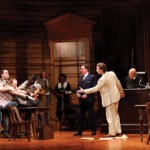
Bob Crowley who designed the off-beat simple set in the shape of a quadrangle has in the middle of the living room a red-tufted Victorian couch. In two different instances Laura actually is weirdly pulled out of and later sucked into this couch disappearing from sight. As opposed to a full-scale glass menagerie – we have here only one broken unicorn. There is a l920s trumpet horn phonograph that is never played and a super-clean Oriental rug on the floor. A fire escape to one side is underutilized.
The costumes, also designed by Crowley, seemed out of sync with the Depression era. Cherry Jones in the first act wears an overly-starched natty print ‘mom’ dress with a broad white collar. In the second act, she dons a gone-with-the-wind white lace ballroom gown. Laura, in the second act, wears a short 1920s flapper style party dress which is attractive but it is from the wrong decade and a little too sexy for Laura. Both seemed almost like fancy dress Hallowe’en costumes. The lighting design by Natasha Katz is dim for the most part to lend the dreamy atmosphere of the long ago past in Tom’s mind. A lighted candelabra is employed for the Laura/Gentleman Caller scene to good effect.
Watching the play through all of this, I kept wondering what the legendary Laurette Taylors’ performance was like. Other great star actresses come to mind who might have been great as Amanda like Shirley Booth, Geraldine Page, and Kim Stanley. Some who have in the past actually tackled the difficult challenging role on stage or on film include Jessica Lange, Jo Van Fleet, Gertrude Lawrence, Sally Field, Joanne Woodward, and there was a chatty spinster-esque New England grand dame interpretation by Miss Katherine Hepburn.
I also pondered after seeing this directors’ version of the play on what Tennessee Williams would have thought about the proceedings and all the raves. The raves I am sure would have given him a kick. What later came to mind for me personally was being seated at a table at Sardi’s at the opening night party of Robert Patrick’s Kennedy’s Children starring Shirley Knight (yes, she could now play Amanda). At the same table sat Tennessee Williams with an elegant, grey-haired lady in a dusty-rose, crepe dress. Tennessee in a slow southern drawl said “Would you like to meet my sister Rose?” What a moment. This was the actual Laura and she exuded a real Belle of the South charm. Stories of her mental problems abound; but that night with her brother Tom/Tennessee at her side she seemed to shine.
The Glass Menagerie by Tennessee Williams is at the Booth Theatre, 222 West 45th Street at Shubert Alley


Robert Heide has written a brilliant, insightful review. I haven’t seen this production, and have no idea if I will agree with him when I do, but his writing is persuasive and even brave, considering all the superlatives this production his garnered. Write on, Robert!