
By Robert Heide
“Candy Darling is a Saint.” Rochelle Owens, Poet and Playwright (Futz, Beclch)
“A true star.” John Waters
“There—you look just like Pat Nixon.” Candy’s mother after helping her bleach her hair blonde.
“Candy and Taffy, Hope you both are well, please come see us at the citadel.” Lyrics from the Rolling Stones song.
“Having a vagina was not the answer to her problems—she just wanted to be an MGM movie star.” Fran Lebowitz
“Hey Babe, take a walk on the wild side” Lou Reed singing about Candy
“You can only go so far.” Holly Woodlawn
“On looks alone, you’ve got the part.” Busby Berkeley at the Broadway casting call of No No Nannette

Helen ‘the Queen of Off Off Broadway’ Hanft said: “at some event or other, my father and my uncle were very courtly to her, both of them getting up when she came into the room. They never did that before. When she left, I told them she was not born a girl; my uncle’s jaw dropped to the floor and my father said in awe, “Well, God Bless her, she certainly pulled it off”
“Death, I’m waiting for it”; “I’ve had small parts in big pictures, and big parts in small pictures”; “Friends who get sex change operations are just boring—not marvelous anymore.” Candy Darling
The first time I saw Candy Darling was in a play entitled Glamour, Glory and Gold, The Life and Legend of Nola Noonan—Goddess and Star written by Jackie Curtis with Ron Link, a good friend of mine, who was also the director. The year was 1967 or 1968 and it was performed at Bastiano’s Cellar Studio, an off-off Broadway theater in the East Village. Candy, who was born James Lawrence Slattery in Massapequa Park in 1944 and died at age 30 in New York City in 1974—yes, there was a boy lurking under all the drag queen dime-store pancake make-up, blue eye shadow, false eyelashes and thick red lipstick—played the lead part of Nola Noonan; Melba La Rose Jr. played Jean Harlow and Robert De Niro enacted over a dozen different parts in the gender bending production, one of many written and directed by Jackie Curtis, an on again, off again, drag queen/cross dresser, who grew up in the East Village in an apartment over Slugger Ann’s Bar on Second Avenue. Slugger Ann was Jackie’s grandmother. One day the street tough Jackie was Barbara Stanwyck, the next day James Dean and he and Candy quickly became constant companions.
In those days I parked my ‘54 Plymouth convertible on Christopher Street in front of my house and I often found one or the other or both of these unconventional characters sitting in the car when I came out the door, all dressed up as if expecting a ride out the Holland Tunnel onto the highways and byways of New Jersey. Early on, in her off-off Broadway days, visiting with me at my place, Candy bonded with two actresses Lisa Beth Talbot and Linda Eskenas, indulging in chatty ‘girl talk’ practically ignoring us guys. She happily posed for pictures wearing an American flag, and with our Persian kitty cat Cyrus beneath a colorful Bert Stern poster of Marilyn Monroe. One night we made an audio tape. Candy played Joan Bennett breathlessly exclaiming, “An actress needs a thousand dollars, just for a decent wardrobe. I want furs, jewels, an apartment on Fifth Avenue. These producers won’t give me a second look.” And switching to another character, Kim Novak in Picnic, “I don’t want to go to the picnic Mom!” and then “I don’t need you, I don’t need anybody. I’m Jeanne Eagels!!”
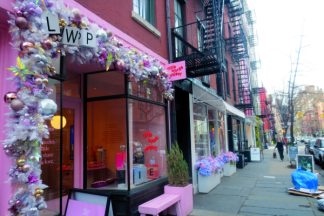
Later, another boy, from Puerto Rico, who transformed himself into Holly Woodlawn, joined the duo and they became quite the threesome in the off-off Broadway heyday of the late sixties and early seventies, eventually breaking into the movies in Andy Warhol’s films Flesh (1968) and Women in Revolt (1971), both directed by Paul Morrissey and as well they performed at places like La Mama and the WPA where Jackie premiered his play Vain Victory—Vicissitudes of the Damned, starring himself, Candy, and a bevy of Warhol ‘superstars’ including Agosto Machado, Mario Montez, Taylor Mead, Paul Ambrose, Ondine, Lucian V. Truscott IV, and Jay and James Johnson. After one of these madcap performances we met up with Candy at Phoebe’s, a bar/bistro on the Bowery where she was sitting at the front booth with a handsome cowboy type guy. Apparently, under the table, he put his pointy cowboy boot in her crotch which prompted the no-nonsense, ladylike Candy to conk him hard over the head with her heavy glass beer mug and with blood flowing the whole place erupted into a full scale melee. Later a waiter refused to let her in the ladies room, a common problem she encountered in those days. She was also denied access to the men’s room! Candy never had gender re-assignment surgery, but she was on her way with hormone treatments using a drug, later removed from the market, which very soon led to her early tragic death of leukemia.
In 1972 Small Craft Warnings by Tennessee Williams opened off Broadway at the Truck and Warehouse Theater, a play about lost souls stuck in a bar waiting out a storm with nowhere to go and Candy was cast as a female character by Tennessee himself, and although the play did not garner good reviews, Candy personally received very good notices, and the night I saw it, Tennessee played one of the parts and with another friend William Hickey in the cast, Candy was very touching (and convincing). At this point there was no problem for her using the ‘ladies dressing room’ and afterwards the two of them went out to the clubs, both dressed to the nines—Candy swathed from head to foot in pale cashmere, including a Lana Turner turban, Tennessee in a white suit and Panama hat. One night uptown, not long after that I wandered into the Russian Tea Room, and there, seated in a tufted leather booth was Candy, draped in a white fur stole and dressed in a vintage forties shoulder-padded purple frock adorned with a large Art Deco rhinestone brooch, chatting with the inimitable Zsa Zsa Gabor. When Candy left to go to the powder room, Zsa Zsa, ordering a round of Vodka Martinis exclaimed to me, “That is the most beautiful woman I have ever met!” After her death, the following note was sent out to Candy’s friends: “Before my death I had no desire for life. Even with all my friends and my career on the upswing I felt too empty to go on in this unreal existence. I am just so bored by everything. You might say bored to death.”
Robert Heide’s books, including his latest publication, Robert Heide 25 Plays are available on Amazon, as are the following:
My Face for the World to See—The Diaries, Letters and Drawings of Candy Darling, Andy Warhol Superstar edited by Jeremiah Newton—a soft, pink faux leather book with a lock and three keys hanging from it published by Hardy Marks Books, Honolulu, Hawaii
2010 feature length documentary Beautiful Darling produced by Jeremiah Newton, written and directed by James Rasin; Candy’s diary excerpts read by Chloe Sevigny and with talking heads that include, among others, myself, Gerardo Malanga, Penny Arcade, Melba La Rose, Jr., Paul Morrissey, Peter Bogdanovitch, Paul Ambrose, Helen Hanft, Agosto Machado, Lou Reed, Michael J. Pollard, Taylor Mead, Valerie Solanas, Fran Lebowitz, Sam Green, Ruby Lynn Reyner, Bob Colacello and Jayne County.


great article.