By Annunziata Gianzero
Black lives matter. Blue lives matter. Oscars so white. Equal work for equal pay. Hashtag it all you want. Or post your opinion and collect a bunch of “likes.” But it’s not enough to identify the problem. That’s just “social media,” whether you employ technological methods or old-fashioned human conversation. It’s also important to remember that the point of all of this awareness-raising is to drive action—to actually DO something about these issues.
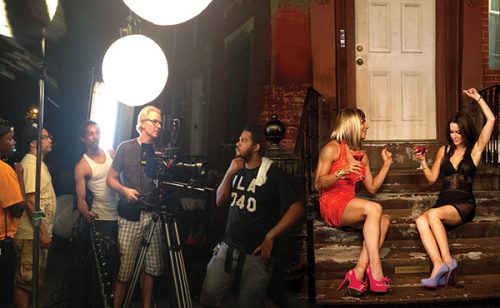
NY DIVERSITY IN ACTION: In front of and behind the camera, the cast and crew of Battery Park. Photo credit: Mandy MacDonald.
There is a shocking gender and race disparity in show business. If you don’t believe that there’s a problem, have a look at the annual Hollywood diversity reports, which is produced by the Bunche Center at UCLA. It’s jaw-dropping. There is no argument against those numbers. As Executive Director of New York Women in Film & Television, Terry Lawler, sums it up: “There is an indefensible bias in this industry against women and people of color.”
The Writers Guild of America, East (WGAE), the Directors Guild of America (DGA), the New York Civil Liberties Union (NYCLU), New York Women in Film & Television, and their respective members, together with Assemblyman Keith Wright and Senator Kemp Hannon, have all been actively involved in doing something about that—legislating at the state level—unpacking these controversial issues, advocating for social change, and formulating effective strategies to begin to correct these imbalances.
And that’s exactly what Senate Bill 5448a (which they all supported) had proposed to do. (https://www.nysenate.gov/legislation/bills/2015/S5448/amendment/A) In last month’s issue, we outlined the advantages of filming in New York and how the Empire State Tax Credit (as well as other local incentives) is providing New York with the industry muscle to resolutely address the disproportion. We also covered the finer points of how the bill intended to achieve this by earmarking some of the credit toward diverse writers and directors. (“Diversity Matters,” July 2016,https://westviewnews.org/2016/07/diversity-matters/)
However, although the bill had already passed the Assembly, it did not pass the Senate before the legislative session ended on June 16th. Instead, the Senate passed another bill (S3401a, also sponsored by Senator Hannon), a non-inclusionary version of it, which stripped out the provisions addressing diversity, effectively leaving both amendments at a stalemate because neither had passed both houses.
Why is this initiative so important to all of these organizations? It’s clear from their statements that we need to affect change. Bernadette Brown, Deputy Legislative Director for the NYCLU said, “We see the harmful impact of these biases every day.” It is the root of the violence and injustice all of these aforementioned hashtaggers passionately broadcast. Ms. Brown goes on to stress that this bill offers a three-fold opportunity because it’s “not only about retaining artistic talent, it’s about contributing to the economic health of the state by having a healthy inclusive economy which benefits ALL New Yorkers” as well as “providing a strategy to implement social justice because having more people of color and women writers and directors will encourage nuanced storytelling with powerful images and narratives which help to deconstruct harmful beliefs and de-program unconscious biases.”
Tom Fontana, (writer/creator of HBO’s Oz, NBC’s Homicide: Life on the Street and many locally-produced shows), who lives in the West Village, points out that “New York can lead the way in bringing diverse storylines to television that reflect all people’s experiences and views.”
While Ms. Lawler is hopeful that the New York State Senate may reconvene before the end of the year, Mr. Fontana “feel[s] confident that our forward momentum will continue into the next legislative session” because “our coalition has grown in strength and numbers.” The WGAE remains steadfast in its commitment to the initiative and has produced an impactful video by its members (available on their website). Ms. Brown, who is personally passionate about obliterating bias, is even looking forward to “addressing other groups as well.”
These organizations remain constant and positive in the effort to implement social justice and be instrumental in making the entertainment industry a force to constructively address stereotypes. They recognize the power of their content and understand the inherent responsibility to educate, to represent the world authentically, and to serve under-represented communities. And too, they see New York as a leader in this cause.