By Barry Benepe
I saw a building in the air
When I looked, it wasn’t there
It wasn’t there again today
I wish that building would go away
Apologies to William Hughes Mearns
I Saw a Man upon the Stairs
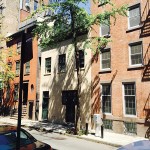
Walking east from Sixth Avenue on the north side of 15th Street alongside a gorgeous row of five story brick buildings, I hardly noticed the out of scale, twenty-four story pyramid set back above. What led to this anomaly on a city street where city zoning rules and decades old precedents say that building facades should line up like soldiers?
Somehow, the architects, FXFOWLE, had followed an approach similar to that of the Durst Organization with 625 West 57th Street (WestView News, August 2015), designed by Bjarke Ingels Group, where, as the building approaches the street, the impact is reduced, leaving the lightest touch on the street itself. This was made possible on West 15th Street by a provision in the zoning law allowing the transfer of development rights from adjacent properties, discussed in previous issues of WestView.
FXFOWLE have displayed a sensitive deftness in utilizing the air rights transferred from the adjacent low rise properties to insert a building which rises gradually in the center of the block rather than at its edges, while maintaining the low height of the buildings surrounding it. The architecture inserts itself into its cityscape in a well-crafted manner. Even the cornice lines of the adjacent school and buildings across the street are respected.
Bruce Fowle played a major role in placing a three acre green roof elsewhere on top of the Javits Center, which will provide a respite for migrating birds as well as a home for resident avians. In this new residence on West 15th Street, the architects have demonstrated a growing awareness of how new buildings can provide a larger context, not by imitating what is already there, but by complementing and preserving the character of their surroundings. Thus we experience both the wonder of the new and the love of the old.
New buildings do not grow in isolation, but define the cityscape in which they are nested. Not only their height and bulk, but their architectural expression will shape the city of the future. Most important will be what happens on the ground. How will our streets be configured and repaved and landscaped to provide a livable environment for those of us on foot? How will motor vehicles be moved and stored with minimum negative impact on pedestrians? These are questions that will have to not only be answered by the Department of Transportation, but also should be on the minds of all concerned with the future of our city
Next month, a look from the St. Vincent Triangle.