
“When President Kennedy shook my hand in 1962, I was considered ‘a criminal, mentally ill, involved in illegal activities.’ He would have had to fire me [from the Peace Corps] since no government agency was allowed to employ homosexuals.”
This is how the State Department’s Tom Gallagher opened his introduction to an LGBT tour group standing outside the Stonewall Inn on June 21st. He was reminding his young listeners where things stood in 1969, when the gays at the Stonewall protested the police raid, sparking the revolution that started to turn things around.
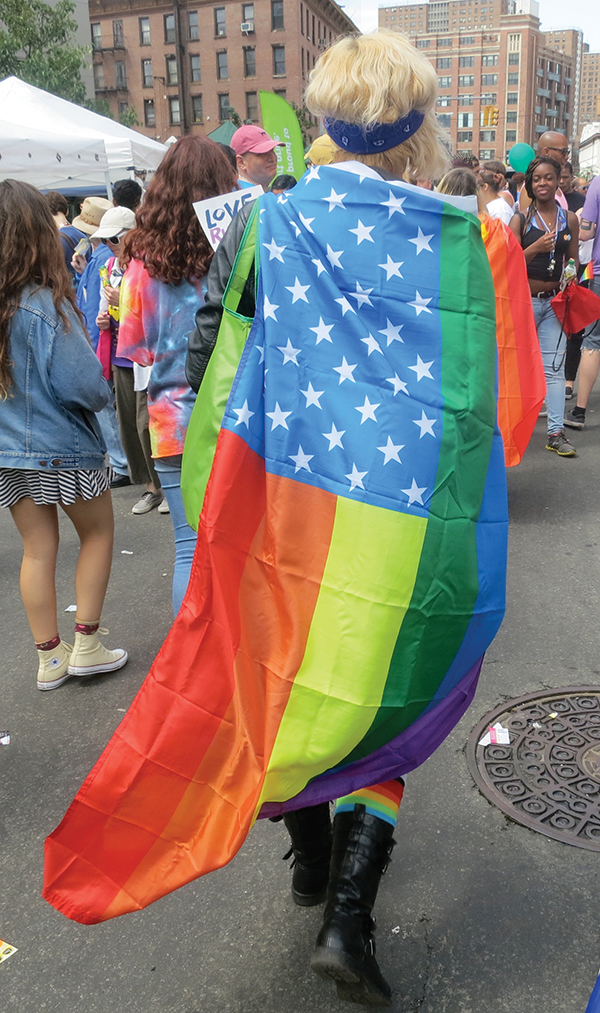
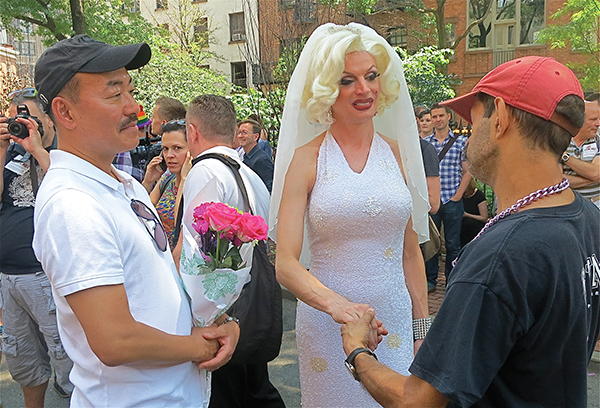
It was the beginning of a watershed week for LGBT rights. On Wednesday the Inn was given landmark status and on Friday Gay Pride weekend got an early start when crowds flocked to Sheridan Square to celebrate the Supreme Court’s Gay Marriage decision. At first there was a little rain on Sunday’s Parade, but then the sun broke through and there were rainbows everywhere
It Was Not Easy to be Gay Back Then
Oh wow! When I read the date “1962” a time when you could be fired from a government job for being a homosexual, I remembered that I was asked to join a design firm as a partner because I was straight— in that very same year! -George capsis
Why the Gay Marriage Decision Is Important to Everyone –By Arthur Z. Schwartz
Friday, June 26, 2015 will live as a historic day in American Constitutional history. Yes, it is a day when the Supreme Court issued a ruling affirming the rights of millions of people—a decision up there with , which struck down the concept of “separate but equal” schools for Whites and Blacks, and , which legalized abortion but did so in the context of affirming the right of women to control their own bodies.
The Gay Marriage decision, (there’s a mouthful), is premised on the notion that the Fourteenth Amendment to the Constitution, which followed the Civil War, is a living text designed to protect Americans from invidious discrimination. The Amendment simply says, “No state shall make or enforce any law which shall abridge the privileges or immunities of citizens of the United States; nor shall any state deprive any person of life, liberty, or property, without due process of law; nor deny to any person within its jurisdiction the equal protection of the laws.” Its language is amazingly sweeping, perhaps as sweeping as any governing document other than the Declaration of Independence. But it has not always been applied in the way it was intended, and—as Justice Kennedy explained—it was not intended to be a narrowly written law designed only to prevent race discrimination.
It is apparent, if you are Gay or Lesbian, why the decision is important to you. It wipes away almost every restriction on your civil liberties (which are rights affected by government action), not just the right to marry. And by civil liberties, I am referring to laws and rules enacted by the government for “straights.” It is not just an interesting celebratory moment. Justice Kennedy reaffirmed that our “nation’s courts are open to injured individuals who come to them to vindicate their own direct, personal stake” in the Constitution, “even if the broader public disagrees.” It is a message to all of us to stand up to injustice, to stand up for what is right, and to make judges open their eyes, to be creative and to address issues of great moment, particularly those that affect individual liberty.
In this quick-paced internet world, always in motion, where the government can often loom so large, we can step back sometimes and say “No.” And sometimes we will win.
Arthur Schwartz is the Democratic District Leader for Greenwich Village.
Statement from Justice Kennedy—George Capsis
“The nature of injustice is that we may not always see it in our own times. The generations that wrote and ratified the Bill of Rights and the Fourteenth Amendment did not presume to know the extent of freedom in all of its dimensions, and so they entrusted to future generations a charter protecting the right of all persons to enjoy liberty as we learn its meaning. When new insight reveals discord between the Constitution’s central protections and a received legal stricture, a claim to liberty must be addressed….
The dynamic of our constitutional system is that individuals need not await legislative action before asserting a fundamental right. The Nation’s courts are open to injured individuals who come to them to vindicate their own direct, personal stake in our basic charter. An individual can invoke a right to constitutional protection when he or she is harmed, even if the broader public disagrees and even if the legislature refuses to act. The idea of the Constitution ‘was to withdraw certain subjects from the vicissitudes of political controversy, to place them beyond the reach of majorities and officials and to establish them as legal principles to be applied by the courts.’”
Justice Anthony Kennedy, majority opinion, OBERGEFELL ET AL. v. HODGES, DIRECTOR, OHIO DEPARTMENT OF HEALTH, decided June 26, 2015.
Photos by Maggie Berkvist
