One hundred fifty years ago, horses dominated all land transportation in NYC. People and freight came mostly by water, but then you walked or you depended on horses. Streets needed to be paved just to make it possible to get around, or else you sank in the mud and ruts, water mixed with manure.
For those who could afford a horse and carriage, having a place to store and care for them was essential. Therefore, on every block there would be a carriage house in the backyard of homes, or a separate structure nearby for that purpose. The horses needed grooms and veterinary care; the carriages needed drivers and repairmen.
The transformation of the stables to other uses began a long time ago and most have been demolished. The structures that remain have been converted primarily for residences. As a type of architecture, these former stables now add variety to our streetscapes. Surprisingly perhaps, the stables had distinctive attributes that allow us to still pick them out.
In those days when the mud and sewage in the streets created very unsanitary conditions, no one would think of entering a home, or even a business, from the sidewalk grade; one needed to step up and out of the muck first. So a large opening at the street level for carriages to enter easily became a distinguishing feature for stable and carriage garages, and that distinction remains today.
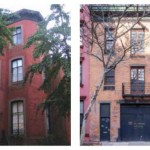
The former stable at 129 Charles Street is our first study example. It was constructed for Herman Thalmann in 1897 by architect Henry Andersen. This four-story vernacular style brick with stone trim structure had its stable on the lower levels, and the Thalmann’s single family dwelling on the upper floors.
The original structure had two stable openings and an entrance door on the ground floor, set between four cast iron posts and under an iron beam. Above the beam is an historic stone plaque with “H. Thalman.” (sic) engraved into it, and there is a horse head keystone over the center third floor window arch.
In an unusual history, the Thalmann’s sold it at auction in 1902, but in 1923 Henry J. Comens purchased the property for his eponymous trucking firm, also residing there with his wife Helen from 1913 until at least 1934. The Comens’ also owned the adjacent federal style townhouse at 131 Charles, ca.1834, from 1925 to 1940. The cornice was removed prior to 1939, and the ground floor was heavily altered. 129 Charles was converted to a garage and machine shop in 1950, then to storage and photo studio in 1972.
Most recently, a new owner has remodeled and converted the building into a single family dwelling with a two-car garage. The new doors and entry framing of cast iron, the windows, and the ornate cornice have all been restored, following a trend in the West Village to respect the original character of its buildings by its new owners.
Stroll around the neighborhood and see if you can pick out other conversions. Next month we will study another historic stable building.