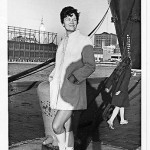
The New York Public Library’s history of the Jefferson Market Library states it was originally a courthouse. It goes on, “The courthouse was briefly the center of national attention in 1906, when Harry K. Thaw was tried [there] for the murder of architect Stanford White.” And it claims that around 1929, Mae West was tried there on obscenity charges over her play “Sex.” Neither claim is true.
But the NYPL’s history correctly reports that Stephen Crane, whose “Red Badge of Courage” had been a recent success, testified in the Jefferson Market courthouse on behalf of a woman charged with prostitution. So let’s begin there.
In the early hours of September 16, 1896, Crane was delving into the Tenderloin District for articles he had agreed to write for William Randolph Hearst’s New York Journal. He was present when police officer Charles Becker arrested a woman named Ruby Young, who had convictions for prostitution under the name Dora Clark, and a chorus girl acquaintance of Crane. This girl claimed Crane was her husband and when Crane did not demur, Becker released her and marched Young/Clark off to the 19th precinct station (the Tenderloin station house) on West 30th Street.
Dora Clark, aged 27, residing at 137 East 81st Street, appeared in the Jefferson Market Magistrates Court before Magistrate Robert C. Connell, on September 16, 1896. (The court being the nearest to the place of arrest.) Crane went to court and after Becker testified, and Clark denied the charge of disorderly conduct, addressed the magistrate from his seat, corroborating Clark’s account. Connell dismissed the case.
For Crane, this was only the beginning. Clark filled a complaint against Becker for harassment. Becker’s trial before a Deputy Police Commissioner at Police HQ, 300 Mulberry Street, took place on the night of October 15, 1896. Again Crane showed up and he testified for Clark. This opened him up to cross-examination about his unorthodox lifestyle. He left the hearing with his reputation badly damaged and soon went abroad.
Officer Becker, though acquitted of Clark’s charges, fared even worse. Promoted to lieutenant, he was later charged with the murder of Herman Rosenthal, a gambler. A jury convicted him, an appeals court threw out the verdict as unsafe, a second jury convicted him, and, still protesting his innocence, he died in the electric chair at Sing Sing on July 30, 1915.
Just before midnight on a hot June 25, 1906, 33-year old Harry K. Thaw shot 52-year old Stanford White three times in the face at the Roof Garden Theater at Madison Square Garden. The Garden was then located at the north-east corner of Madison Square. Thaw’s wife was Evelyn Nesbit, a 22-year old model. White was her first seducer and Thaw knew it.
Police Officer Anthony Debes was first on the scene. He arrested Thaw and took him to the Tenderloin station house. Then Thaw was transported to Police HQ, and at 3:00 AM charged with White’s murder. He spent the rest of the night in The Tombs.
Later that day, June 26, 1906, Thaw, of 15 Lafayette Square, appeared before Magistrate Barlow at the Jefferson Market Magistrates Court. In the spidery handwriting in the court docket “Homicide” is writ large next to Thaw’s entry.
Thaw was remanded without bail for the grand jury and returned to The Tombs. This was his only appearance in the Jefferson Market courthouse. His trial began on February 4, 1907, before the Supreme Court Criminal Division on Centre Street, Justice Fitzgerald presiding, with the jury sequestered. On April 12, 1907, the jury declared itself deadlocked between verdicts of guilty and not guilty by reason of insanity. On February 1, 1908, a second jury found Thaw not guilty by reason of insanity. He was committed to the State Asylum for the Criminally Insane at Mattawan, near Poughkeepsie.
Thaw’s prosecutor was William Travers Jerome, the district attorney, first elected in 1901 on an anti-corruption ticket, and re-elected in 1905. Jerome had a first cousin, Jeanette Jerome, five years older. Known as Jennie, she married an English aristocrat and on November 30, 1874, aged 20, gave birth to a son named Winston – as in Churchill.
Mae West spent the night of February 9-10, 1927, in the Jefferson Market prison. It happened this way. She was a Brooklyn born writer, producer, and star of risqué plays. On February 9, with Mayor Walker out of town, and prodded by the Society for the Prevention of Vice, the police raided her play “Sex” at Daley’s Theater on 63rd Street and arrested the entire 22-strong company. The play had opened without protest on April 26, 1926.
The 22 were taken first to the local station house and then to the Men’s Night Court on East 57th Street. Mae West, whose age was recorded as 26 (she was 33), and co-star Barry O’Neil, were docket numbers 1795 and 1796. Magistrate John V. Flood set Mae’s bail at $1,000. Unable to raise that in the middle of the night she went to jail for a few hours. Six days later, Flood remanded the principals in the company to the Court of Special Sessions to be tried on three public morals charges.
But Mae’s lawyers obtained a jury trial in the Court of General Sessions on Centre Street on the ground that this was a matter of public importance. After a grand jury indictment her trial began before Justice George L. Donnellan and a jury on March 28, 1927. The jury’s guilty verdict followed on April 5, and the sentence – 10 days in the Welfare Island workhouse and a $500 fine – on April 19. She served eight days.
The next year there was a repeat performance by the authorities over her play “The Pleasure Man.” Her trial began on March 17, 1930, and ended in a hung jury. There was no retrial. In 1932, she left for Hollywood and became the Mae West of (the apocryphal) “Is that a gun in your pocket or are you just glad to see me?” fame.
Two years after Mae’s night in the Jefferson Market prison the City closed it, along with the market. Demolition began on September 16, 1929. The Women’s House of Detention replaced it, opening on March 29, 1932.
In the fall of 1945, Chief Magistrate Edgar Bromberger decided to streamline the City’s Magistrates Courts. This included moving all the functions of the Jefferson Market court to a new court complex at 300 Mulberry Street, the former police HQ.
Construction delays at Mulberry Street postponed the implementation of the reorganization for several weeks, but on March 4, 1946, the Jefferson Market court closed its doors forever. And, after a famous campaign led by Margaret Gayle and others, it opened on November 27, 1967, as our branch library.
Sources:
Dash, M., “Satan’s Circus”, Granta Books, 2008.
Louvish, S., “Mae West: ‘It Ain’t No Sin’”, St. Martins, 2006.
O’Connor, R., “Courtroom Warrior: The Combative Career of William Travers Jerome”, Little Brown, 1963.
Sorrentino, P., “Stephen Crane: A Life of Fire”, Belknap Press, 2014.
“Three Plays by Mae West”, Schlissel, L., Ed., New York: Routledge, 1997.
Uruburu, P., “American Eve” (Evelyn Nesbit, Stanford White: The Birth of the “It” Girl and the Crime of the Century), Riverhead Books, 2008.
New York Times Archives.
New York Herald Tribune Archives.
New York City Municipal Archives.
And thanks to Sheryl Woodruff, Greenwich Village Society for Historic Preservation.
Clive I. Morrick is a semi-retired attorney who has lived in Greenwich Village since 1977.