
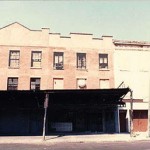
Llewyn Davis on MacDougal Street in 1961
The lyric of what is probably Bob Dylan’s most famous song poses the question – “How does it feel to be on your own, a complete unknown – like a rolling stone?” In this apocalyptic song, Dylan is certainly not referring to Mick Jagger or any of the other rockin’ Stones, but to a bunch of other folk singers hanging out in the Village who never would never quite make it in terms of the world of fame, money, and over-the-top success in the recording business. The fictional character Joel and Ethan Coen focus in on in their new film Inside Llewyn Davis is portrayed as just the kind of outsider loser ‘folkie’ that Dylan is singing about in his hit tune Like a Rolling Stone.
This movie tells the story of Llewyn played by Oscar Isaacs who puts forth a brilliant understated performance of a drifter couch-surfing singer who is out to make a name for himself in the Greenwich Village folk scene of 1961. It was said that this messed up neurotic character is loosely based upon the legendary Dave Van Ronk who never got the kind of recording contract deals given to Bob Dylan, Peter, Paul and Mary, Judy Collins, Joan Baez or Paul Simon and Art Garfunkel. Other talented folk singers of the Sixties singing at places like the Gaslight Café or Café Wha? on MacDougal Street like Tom Paxton, Tom Rush, Hamilton Camp, David Blue, Patrick Sky, Eric Anderson and a host of others were out there – made records, but never hit the big time jackpot.
In the story Llewyn had recorded an LP album entitled Inside Llewyn Davis, thus the title of the film, but the album sales went nowhere and hundreds of copies had to be dumped as throwaways by the record producers. Llewyn carries some of these rejects around hoping someone will listen. Though a gifted singer, Llewyn is an abrasive character whose primary talent seems to be putting people off and screwing up whatever he touches personally and professionally. It seems that his folksinging partner who broke up the act by committing suicide left Llewyn in a state of depression, rage, and bitterness. This persistent chip-on-the shoulder attitude then sets him apart from the rest of humanity.
The film itself as a portrait of one week in the life of a loser is masterful in its detail and the movie itself unfolds as in a realistic dream nightmare that exists in a world of non-time or timelessness. The adventures or misadventures of the main character are not unlike those of Charlie Chaplin’s Little Tramp but without the comic overtones of the master. Nevertheless there is a kind of comedy that emerges here. When Llewyn is asked by the manager of the Gaslight what he thinks of a group of male folksingers wearing Irish hand knit white wool sweaters his only comment is, “I like their sweaters.” I found the style of the film to be Antonioniesque in the manner of L’Aventura with Llewyn here seen as an existential loner living on the edge of the abyss and not knowing in which direction to turn or to proceed. The character lives only moment to moment. In one segment, Llewyn is cat-sitting at a vacationing couples Village pad when the orange Tabby he is in charge of darts out the door and disappears onto the street. A desperate frantic search leads nowhere; but after a time the cat who is named Ulysses finds his way back by himself. Llewyn with no place to go decides to leave the Village scene to hit the road for Chicago in search of work.
In a long on-the-road sequence and in a car driven by a spaced-out hipster guitarist who was hired by a fat old degenerate heroin addict who is in the back seat groaning, moaning, cursing, and dying all the way, they are stopped by highway patrolmen, the driver and the fat man are taken off, the car impounded, and Llewyn is left like a character out of Kerouac to hitchhike onwards. In an icy winter Chicago he auditions for a club owner acted in a menacing manner by F. Murray Abraham. Isaacs as Llewyn does a moving rendition of the song The Death of Queen Ann but is told outright by the Abraham character, “I don’t see any money here.”
Llewyn returns to New York only to realize that nothing has changed and his Kafkaesque – on trial – situation is the same as it was when he left in search of greener pastures. There is nowhere to run and nowhere to hide. The brightest spot of Inside Llewyn Davis turns out to be the orange Tabby who is back home with his owner. Ulysses the Cat in many ways is a star to be reckoned with. It should be noted that on the cover of the Dylan album Bringing It All Back Home, there is a photo of Dylan with a cat sitting on his lap. Also on the 1963 folk album Inside Dave Van Ronk, a cat sits in the doorway. The films soundtrack CD Inside Llewyn Davis being sold at Starbucks has a photo of Oscar Isaacs carrying his guitar and Ulysses down MacDougal Street. The folk songs on this album are an integral part of the film and add to the luster of it all. There are songs sung by Oscar Isaacs himself throughout but at movie’s end it is a shadowy Bob Dylan who sings the last song Farewell with the implication he is the one who will make it all the way to the top.
There are violent sequences at the beginning and end of the film in which our masochistic non-hero Llewyn is beaten up in a Greenwich Village back alley – ostensibly spelling out the characters need for self-punishment and abuse. Justin Timberlake plays a folksinger who holds his own in every respect in this remarkable film. The incredible vision of cinematographer Bruno Delbonnel creates an ethereal wintertime mist that is at once both mystical and eerie in a metaphysical way.
Those who live in the Village and everyone else should rush to see it. The Coen brothers are the stuff of genius and this may well be their very best film. The New York Times and newspapers across the country are citing it as the best film of the year.


Thank You Robert Heide for the reminder! I certainly will rush out and see this film. I remember seeing the trailer but forgot about it completely. As a Spirit in the arts myself I feel the Souls of the past whenever I am in the back roads of the Village or on an off quiet night . The Village represented a life statement not a bankstatement ! Very much as Sixto Rodriguez of “Searching for Sugarmann” believed. A true artist guards their creativity as a dragonfly does his reed…let go and fly as high as you can, or hold on because of fearand surely die ! As HM Koutoukas would say,” All for Art my Dear!”
Fantastic review! Ciao~Jana
Right on, Robert! I totally agree with your reminders of James Joyce, as well as Kafka – and included might also be Scorsese’s After Hours in a different context. And, like yourself, having lived in and on those mean Village streets back in the day, I really appreciated the recreation of atmosphere. Cats, of course, have been used variously as companions and symbols throughout history [think Egypt] in literature and popular culture, viz Pyewacket, witches, & Breakfast at Tiffanys! They’re notoriously non-conformist, and less predictably affectionate than dogs. How like Llewyn! But I think the Coen boys’ underlying genius here has very much to do with an emotional expression of the creative process itself. Very tricky! The balance between sheer confidence to continue in the face of rejection of others, as well as the ego-sapping rejection of self produces and fuels the anger toward the world. That syndrome: I’m a genius, why can’t they see it? Simultaneously coupled with: I’m total crap, I’ll just give up. I can’t believe how ignored the film has been at awards time.